Jamnagar's brass industry: its potential, its hurdles, and what buyers should know
By Manoj Khande, Founder, BrassRoute · 10 October 2026
Ask an electrical company in Europe, a plumbing distributor in the Gulf or a valve maker in the United States where their small brass parts come from, and there is a good chance the answer is a town on the Gulf of Kutch most of them have never visited: Jamnagar, Gujarat.
Jamnagar is widely known as India's Brass City for brass parts. Government energy studies describe it as one of the largest brass industry clusters in India. Its workshops turn scrap metal into the inserts, terminals, fittings, glands and precision components that sit inside switchboards, taps, gas stoves, meters and machines around the world. This article looks at what makes the cluster strong, what holds it back, and what buyers run into when they try to source from it.
How big is Jamnagar's brass cluster?
Nobody agrees on an exact count, and that is part of the story. A 2020 study for the Bureau of Energy Efficiency and UNIDO counted about 3,500 units: roughly 900 foundries, 150 extrusion plants, 2,100 machining units and 350 electroplating units. The Jamnagar Factory Owners Association puts the figure at more than 5,000 units, and a February 2026 news report cited nearly 8,000. Estimates of employment range from tens of thousands in an older government district profile to more than two lakh people in industry and press estimates.
Most of these are small and medium enterprises, many family-run, concentrated in the GIDC estates at Shankar Tekri and Dared (Phases II and III) and in newer private industrial parks around the city. The industry grew over several decades, with organised growth from the government industrial estates set up in the late 1960s.
What Jamnagar makes
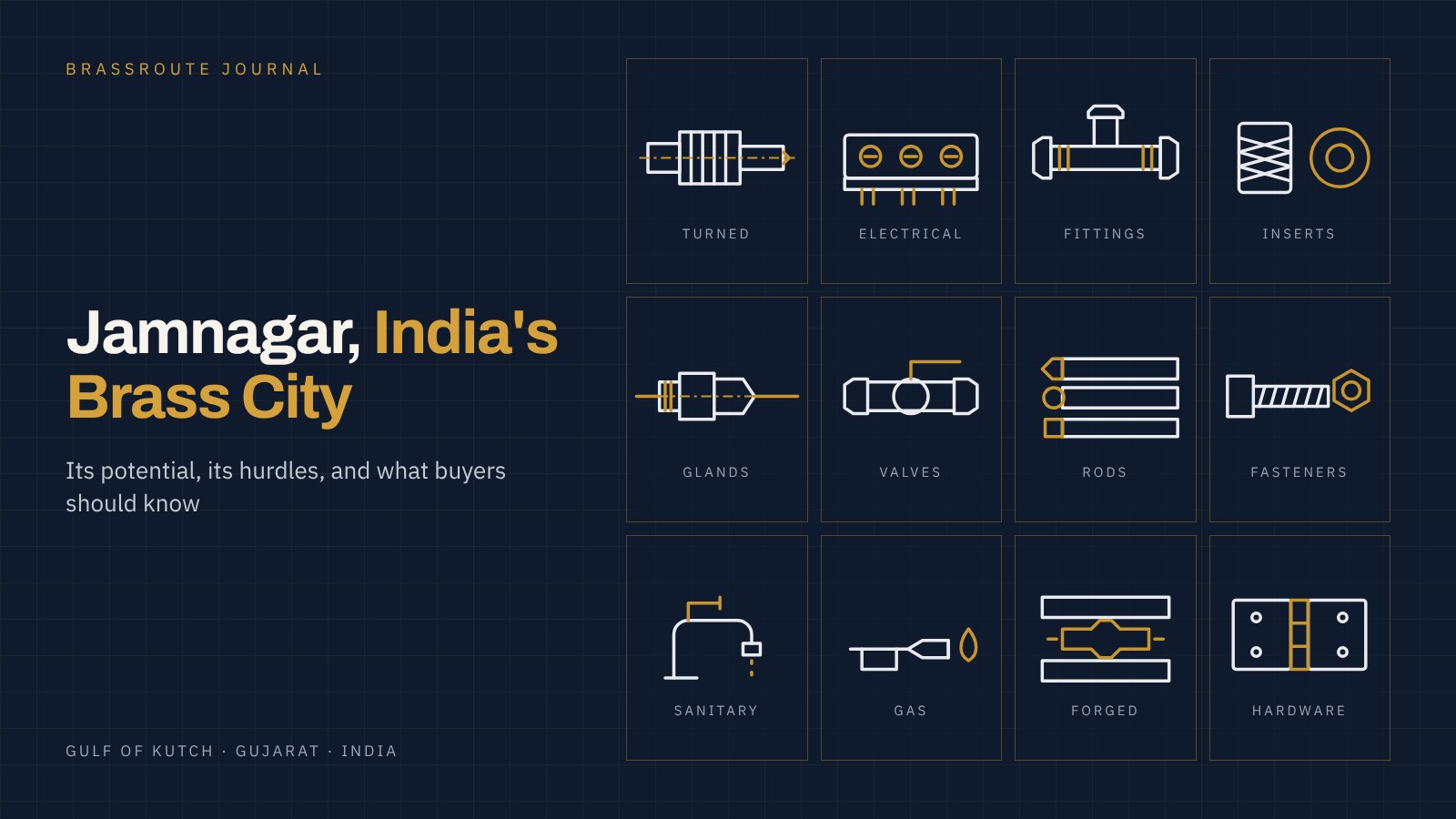
The range is wider than most buyers expect: parts from a gram to several kilograms, covering building hardware, brass rods and wire, sanitary fittings, electrical and earthing accessories, automotive and industrial valves, gas parts, fasteners, pipe fittings, agricultural parts, inserts, bushes, battery terminals, ingots, billets, extrusion rods and wires. Almost every step of the chain happens inside the same city, from melting scrap and extruding rod to forging, CNC turning, plating and packing.
The potential
- Government focus. "Brass Parts" is Jamnagar's listed product under India's One District One Product programme, and Gujarat treats brass parts as a priority cluster, with support for common facility centres, testing labs, credit and export promotion.
- Cheaper raw material imports. The cluster runs largely on recycled scrap. India imported about 0.13 million tonnes of brass "honey" scrap in 2025, mainly from Germany, the UK and the US, and Jamnagar consumes the large majority of it. The Union Budget 2025-26 removed the basic customs duty on copper scrap, which the recycling industry reads as covering brass as well.
- A track record abroad. In 2015 Business Standard reported exports rising from 3 to 4 per cent of the cluster's business to nearly 20 per cent in a few years, with buyers in Europe and the US joining older markets in Africa and the Gulf. The association said then that Indian parts were around 30 per cent cheaper than comparable European ones.
- Steady demand at home and abroad. Electrical, construction, plumbing, automotive and renewable-energy buyers all use brass components, and market reports in 2026 continued to describe steady buying from plumbing and electrical fittings makers.
- A shop window. The cluster's own trade fair, the Jamnagar Industrial International Expo, drew 221 exhibitors and more than 21,000 visitors in February 2025. The next edition is planned for February 2027.
The hurdles Jamnagar's MSMEs face
Raw material prices they cannot control
Brass scrap follows the London Metal Exchange copper price. Copper rose from about $9,800 to $12,500 a tonne during 2025, and Jamnagar's honey scrap rose from about ₹6 lakh to around ₹7.6 lakh a tonne by May 2026. When the metal moves, a small unit's quote moves with it, often after the order is already priced. Margins in mid-2026 were described by market trackers as minimal.
Energy and gas
The 2020 government study found coal pit furnaces running at only 15 to 17 per cent efficiency and limited piped gas. In May 2026 some units cut output or shut intermittently because of gas supply problems. Every rupee spent on fuel is a rupee that cannot go into machines or quality.
Boom and bust cycles
The cluster depends on construction, auto and electrical demand. In 2013 units cut production by around 65 per cent and ran four to five hours a day. Working capital stays tight, and payment delays hurt small units most.
Technology and compliance
Many units still work with older equipment, and the move to cleaner furnaces, CNC machining and documented quality systems costs money that small firms struggle to raise. Environmental compliance, rightly, keeps getting stricter.
Trade policy shocks
Changes in US tariffs during 2025 and 2026, including a separate US duty on the copper content of some copper-alloy products, have made pricing for American buyers harder to predict. Exporters who sell to only one market feel this most.
Reaching buyers at all
This is the hurdle that ties the others together. A unit with excellent machines but no English website, no export team and no presence on international platforms depends on brokers and word of mouth. The buyer never sees the factory, and the factory never sees the buyer.
The hurdles buyers face
Buyers have their own frustrations. Jamnagar suppliers themselves advise buyers about most of these:
- Finding the actual maker. Some listings are trading firms that collect parts from several workshops. Prices can look attractive while batch consistency suffers.
- Comparing like with like. Quotes arrive in different formats, currencies and Incoterms, and raw material can be 40 to 50 per cent of a part's price, so a fair comparison takes work.
- Minimum orders and lead times. Typical minimums run to thousands of pieces for custom parts, with sampling and production taking several weeks. Estimates vary from supplier to supplier.
- Checking who you are dealing with. Certifications, GST registration, machine lists and test reports are worth checking before the first order. Information on many directory sites is not verified.
Where BrassRoute fits
We started BrassRoute because both sides of this market are trying to find each other through too much noise. Our aim is simple: make every brass maker in Jamnagar one search away for a serious buyer, and make every serious buyer one requirement away from several real factory quotes.
- A directory of more than 1,100 Jamnagar manufacturers and traders, organised by product, with each profile's status shown openly. Profiles compiled from public listings are marked unclaimed until the business takes them over.
- One requirement, with your drawing, grade and quantity, sent only to units that make that part. You compare the quotes side by side and deal directly with the factory.
- A daily board of indicative brass and zinc scrap rates, so both sides can see what the metal is doing.
- For manufacturers, a free English-language profile that international buyers can actually find, and a simple way to answer their enquiries.
We are in pre-launch, and we would rather say so than overpromise. The direction is clear: help Jamnagar's small units reach buyers they could never reach alone, and give buyers a straighter route to the people who make their parts.
A short checklist before your first order from Jamnagar
- Share a drawing with the alloy grade (for example CW614N, C36000 or IS 319), tolerances, finish and plating.
- Ask whether the supplier casts or extrudes its own rod, or buys it in.
- Compare quotes on the same Incoterm and quantity, and ask how the price moves with copper.
- Ask for samples, a material test report and, where relevant, a salt-spray or plating test.
- Check the GST registration and any ISO certification, and ask for a video call or factory visit.
If you are sourcing brass parts, you can post a requirement on BrassRoute. If you run a unit in Jamnagar, find your profile and claim it free.
Sources
- Technology Compendium, Jamnagar Brass Cluster (BEE, GEF, UNIDO), September 2020
- Brass City, Jamnagar Industrial International Expo (Jamnagar Factory Owners Association)
- Gujarat: Jamnagar emerges as global brass manufacturing hub with MSME support (IANS), 18 February 2026
- Brief Industrial Profile of Jamnagar District (MSME-DI Ahmedabad)
- ODOP product list, August 2025
- India brass honey scrap imports rise 11% y-o-y in CY25 (BigMint), 16 April 2026
- India brass honey scrap prices remain rangebound; margin pressure persists (BigMint), 1 May 2026
- Budget FY26: zero basic customs duty on copper and zinc scrap (BigMint)
- Surged European export orders revive Jamnagar brass industry (Business Standard), 17 July 2015
- Jamnagar brass units cut production by 65% (Business Standard), 25 March 2013
- The Future of Brass City (Scrap magazine, ISRI), 2010
- Jamnagar Industrial International Expo 2025 (JETRO J-messe trade fair listing)
- Supreme Court rules President lacks IEEPA tariff authority (Cozen O'Connor), 24 February 2026
- Will tightening supply and cost pressures sustain the brass market? (ChemAnalyst), 21 August 2026
Figures are as reported by the sources above on the dates shown. Estimates of the cluster's size vary between sources.
Get quotes from these suppliers
Post your requirement once with your drawing. Our team passes it to Jamnagar units that make this product, and you compare their quotes side by side. Free during pre-launch.